
Factory visit: an Indian furniture maker compares two banders
On November 19 a furniture manufacturer from India spent the day at our plant in Dongguan, with two machines on the agenda: the FM820JCDH skeleton-line and grille bander and the FM468JCD 45° bevel and straight bander. The questions were practical ones — how the joint closes, what happens to a recessed door face, and what the line needs in air and power.
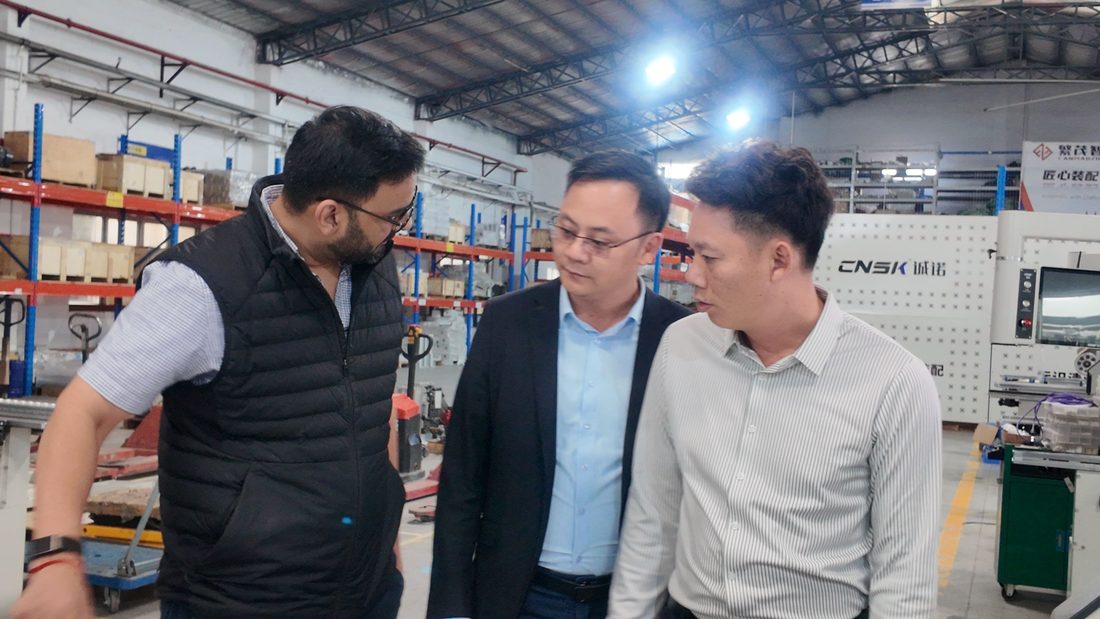
First, the floor
The visit started at the raw material area and worked through the assembly bays to the finished machines. Rows of banders stood ready for dispatch, some already crated, others still open for inspection.
The team spent longer at the partly assembled frames than at the finished ones. The conveyor, the pressure beam and the trimming heads are the parts that decide how a panel behaves once the line is running, and they are covered by sheet metal on a machine that is ready to ship.
Walking the bays is also how a buyer reads capacity: how many frames stand in a row, how far along each one is, and whether the floor is building to orders or building to stock.
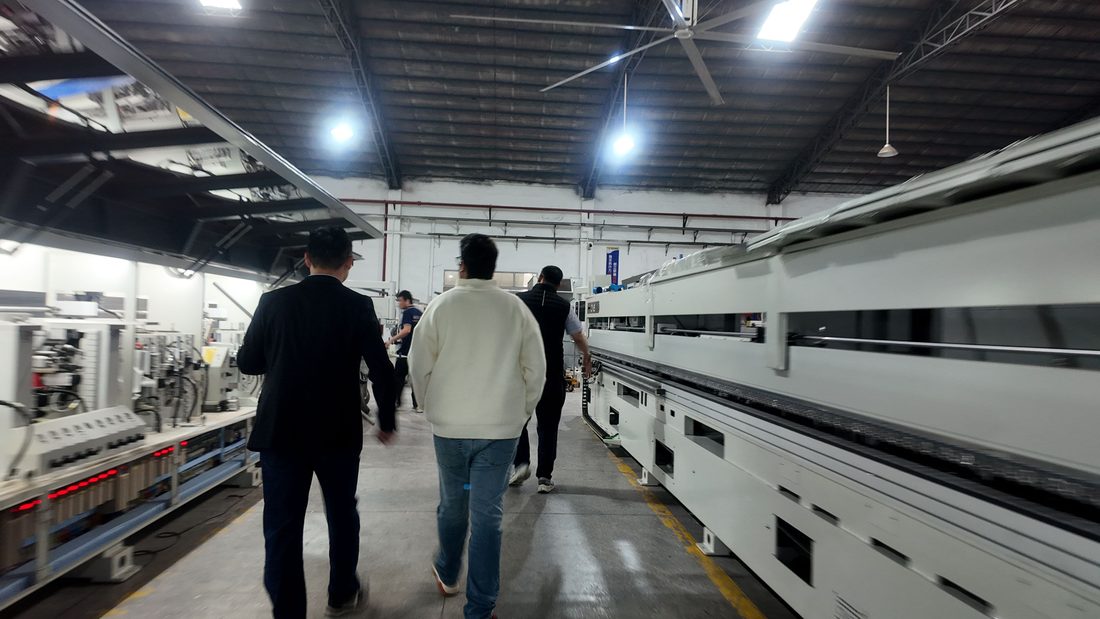
Two machines, two different jobs
The two models look similar from a distance and do different work.
Both were on the agenda because the customer runs both kinds of front, and wanted to judge them against the same panels rather than from two separate brochures.
FM820JCDH is built for skeleton-line doors. A skeleton-line door has a recessed face, and a flat pressure shoe cannot hold it down, so most shops pack the recess flat before banding. This machine carries the panel on a track conveyor under a high-pressure beam instead, and the recessed face goes on as it is. The same bed also produces straight, 35° bevel and grille-slat material, and bands ordinary straight edges. Eighteen processing cells run along 13,020 mm, from skeleton pre-milling and the 35° bevel saw to nail-rack grooving and strip slitting.
FM468JCD is built for handle-free fronts. A 45° bevel and a straight edge are switched with one key and formed in one pass, so the mitre does not need a second machine. Fifteen processing cells sit on a 9,900 mm bed, with an EVA glue pot and a fast-melt tank so the adhesive reaches working temperature and holds it through the shift.
Set side by side, the difference is in what each machine does with the panel face: one holds a recess flat, the other forms an angle on it. Seeing both in one visit is what lets a customer compare them without guessing.

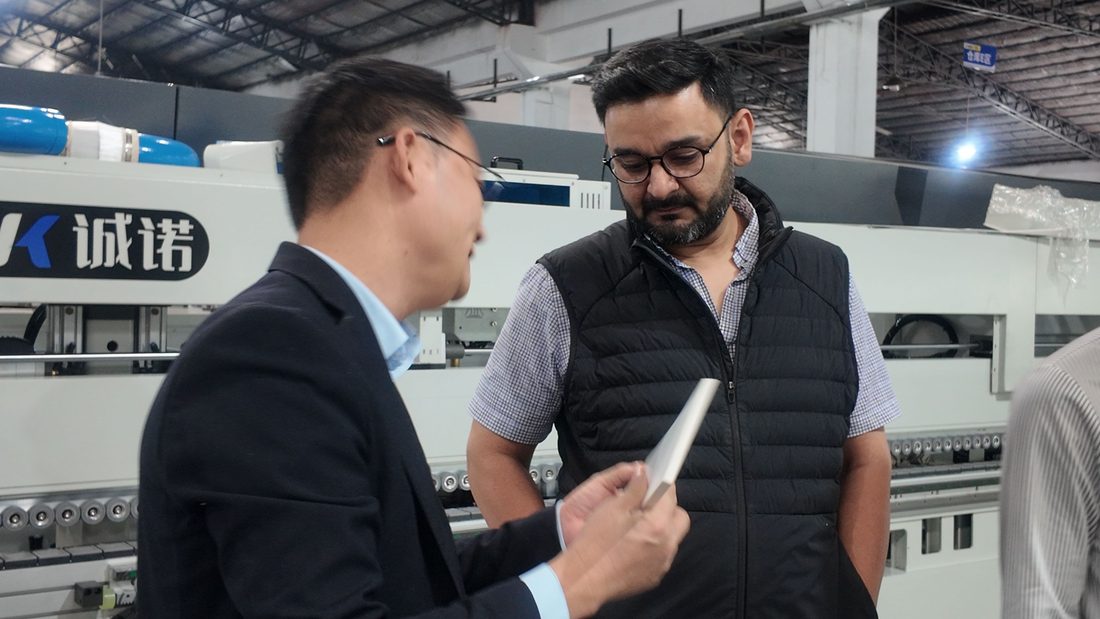
A panel through the line
Most of the visit was spent watching panels, not reading sheets.
From the infeed the sequence is the same on both machines: pre-milling re-finishes the sawn edge, glue goes on, the pressure rollers close the band, then rough and fine trimming, corner rounding, scraping and polishing.
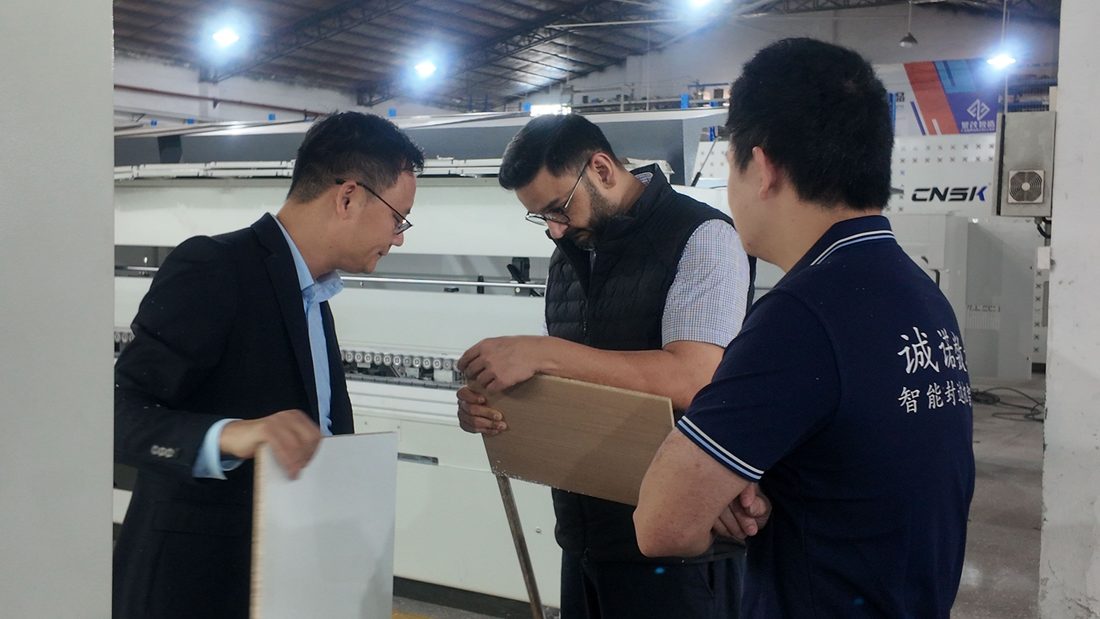
Two things were worth watching closely. The first is the joint: whether the band sits flush with the panel face and no glue line shows at the edge. The second is the corner, because a radius that is not tracked properly shows as a step a thumb can feel.
The panels that came off were checked by hand, then held next to the sample pieces on the showroom rack. That comparison by touch is usually the moment a customer decides.
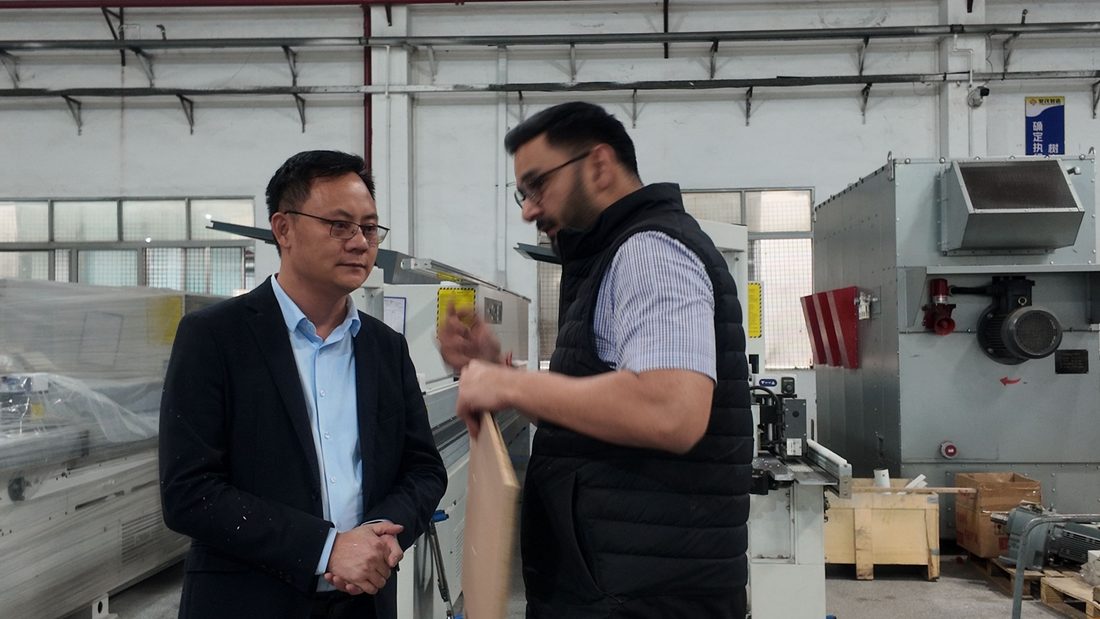
Time at the control screen
Recipes live on the touch screen: band thickness, panel thickness, feed rate, and the values each trimming head works to.
Parameters are set from the screen, so a change from one band thickness to another does not mean the heads have to be reset by hand. On a plant running mixed orders, that is the difference between a changeover measured in minutes and one measured in hours.
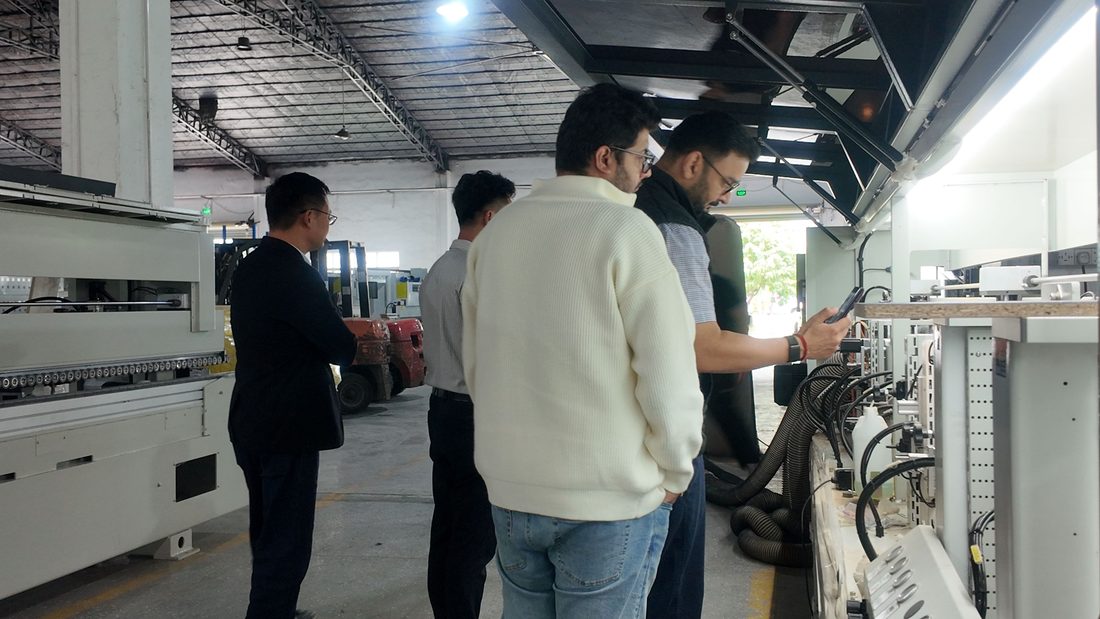
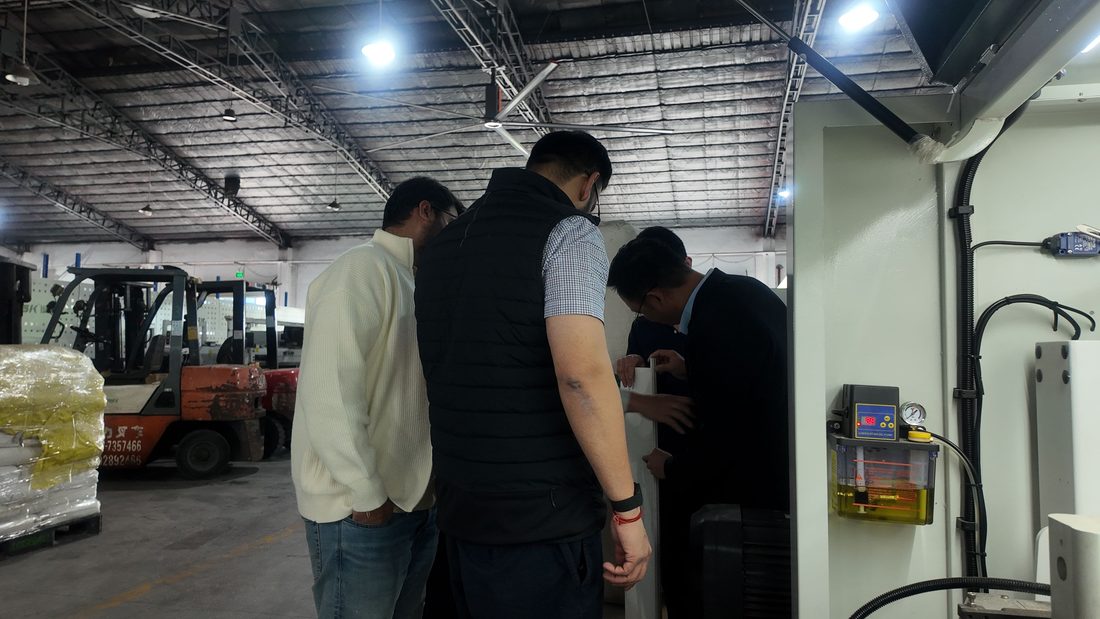
The visiting team went through the screens with our engineers and photographed the trimming stations in detail — the parts that are hard to judge from a brochure. One of the visitors ran the interface himself rather than only watching a demonstration.
What the visit settled
The comparison was made the way it should be: sample panels against freshly banded ones, the same edge looked at from both sides, the corner checked by hand. What the customer raised was consistency — whether the joint closes the same way from the first panel to the last.
Configuration questions covered band widths, the panel thickness range each machine accepts, and the air and power the line needs on site. Those details decide what a factory actually has to install, and they are easier to settle in front of the machine than over email.
Technical data
| Item | FM820JCDH | FM468JCD |
|---|---|---|
| Work it does | Skeleton-line, grille, straight banding | 45° bevel and straight banding |
| Processing cells | 18 (20 with conveyor and screen) | 15 |
| Panel thickness, straight banding | 9–60 mm | 8–60 mm |
| Panel thickness, bevel banding | 15–40 mm | 12–40 mm |
| Panel width, straight / bevel | ≥60 mm / ≥80 mm | ≥40 mm / ≥60 mm |
| Feed speed | 16–23 m/min | 16–23 m/min |
| Band thickness | 0.4–3 mm | — |
| Band width | 12–65 mm | 12–60 mm |
| Input voltage | 380 V | 380 V |
| Air pressure | 0.7 MPa | 0.7 MPa |
| Total power | 60 kW | 24 kW |
| Machine dimensions (L×W×H) | 13020×900×1690 mm | 9900×740×1750 mm |
Figures follow the 2026 configuration sheets. The FM820JCDH sheet also quotes 9–45 mm for straight banding on skeleton-line panels; the range is confirmed on the data sheet issued with the offer.
Bring your own board
A visit is the cheapest way to find out whether a machine suits the panels a plant actually runs. Bring your own board and the line will band it while you watch, which settles more in an hour than a specification sheet settles in a month.
If you are weighing a bander for skeleton-line doors, bevel fronts, or both, send the panel thickness and the band you use and we will set the machine up before you arrive.
The machine in this report
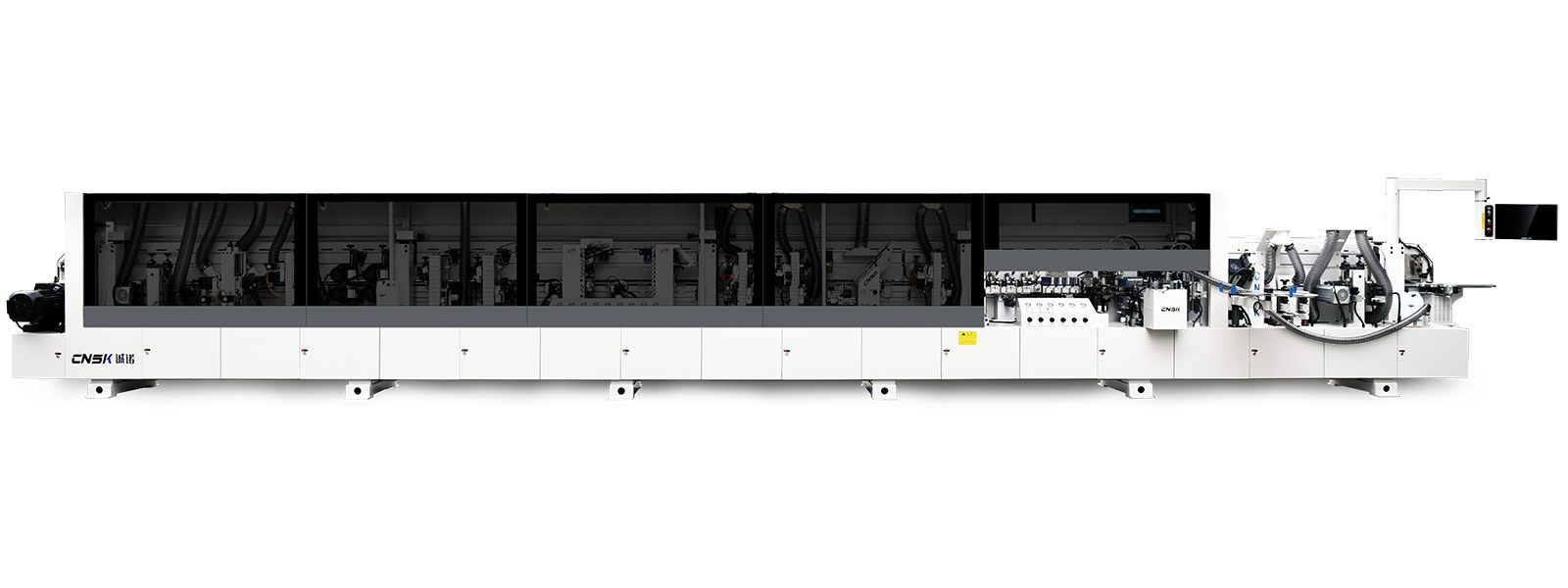
Skeleton-Line Grille Edge Bander
Skeleton-line doors, grille slats and standard straight edge banding on one track-fed 13-metre bed.
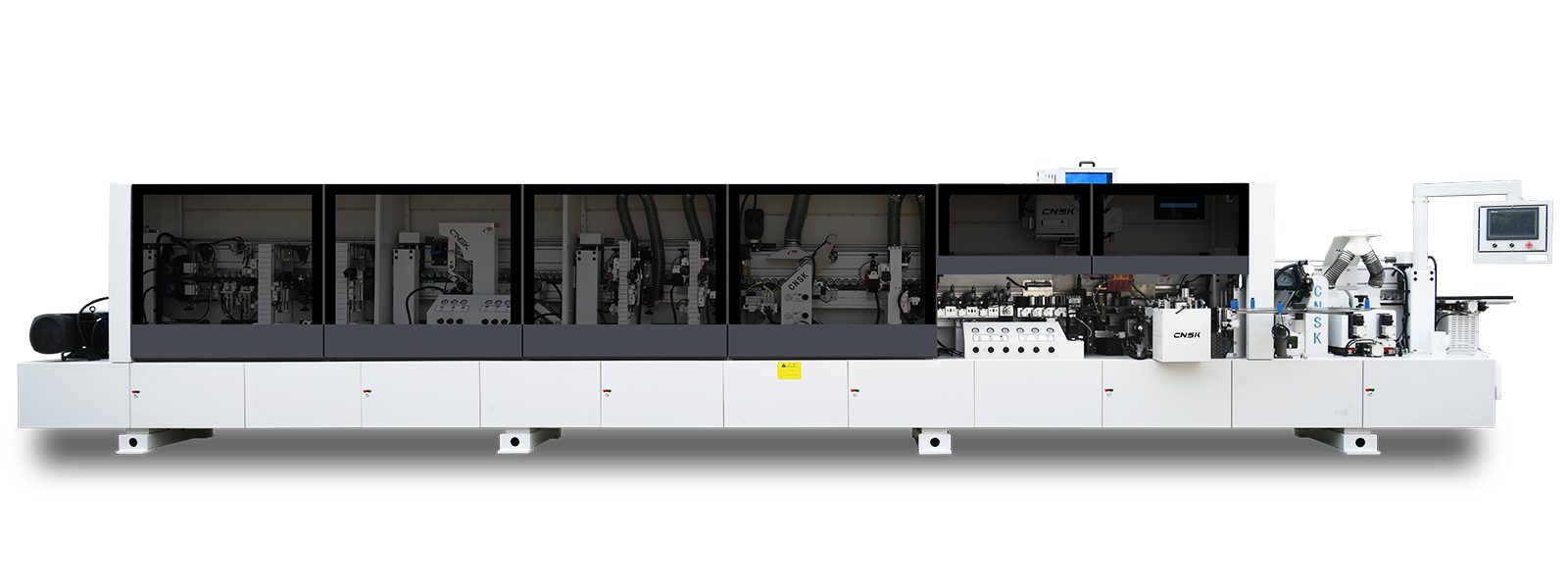
45° Bevel and Straight Edge Bander
45° bevel and straight edge banding, switched with one key, on a 9,900 mm bed.
Send the panel spec. Get a configuration, not a catalogue.
Thickness, width, band material and the profile you sell. That is enough to put a station list and a price against your name.