
Factory visit: Snimay walks the FM820JCDH line
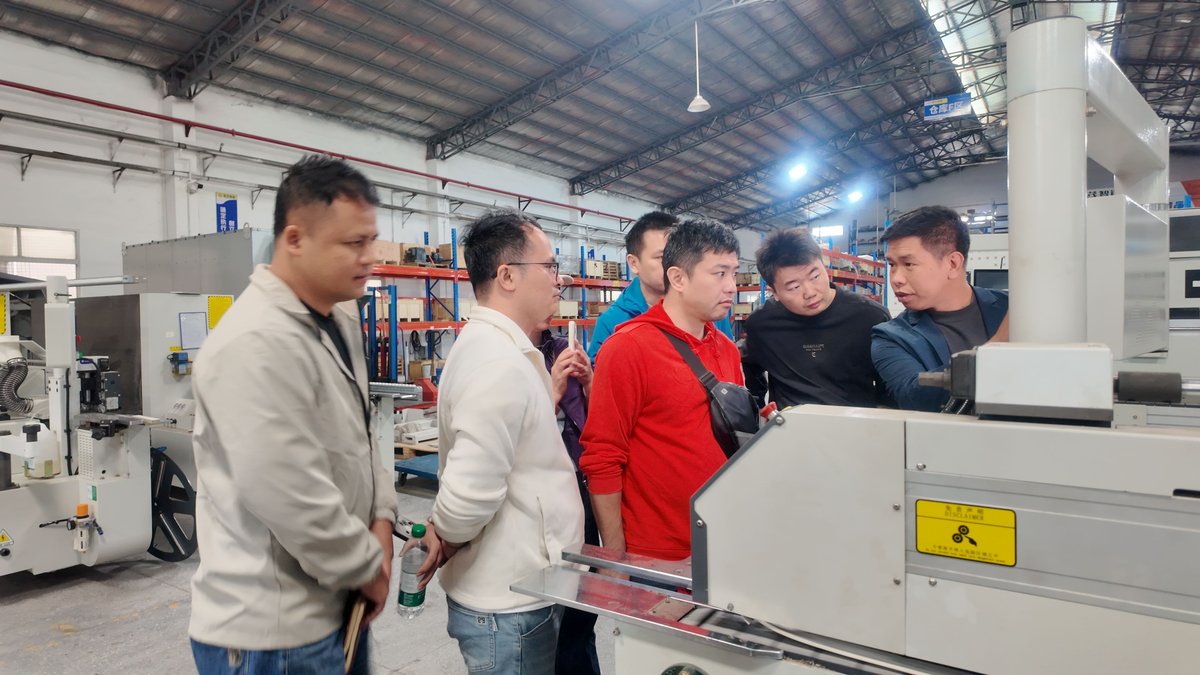
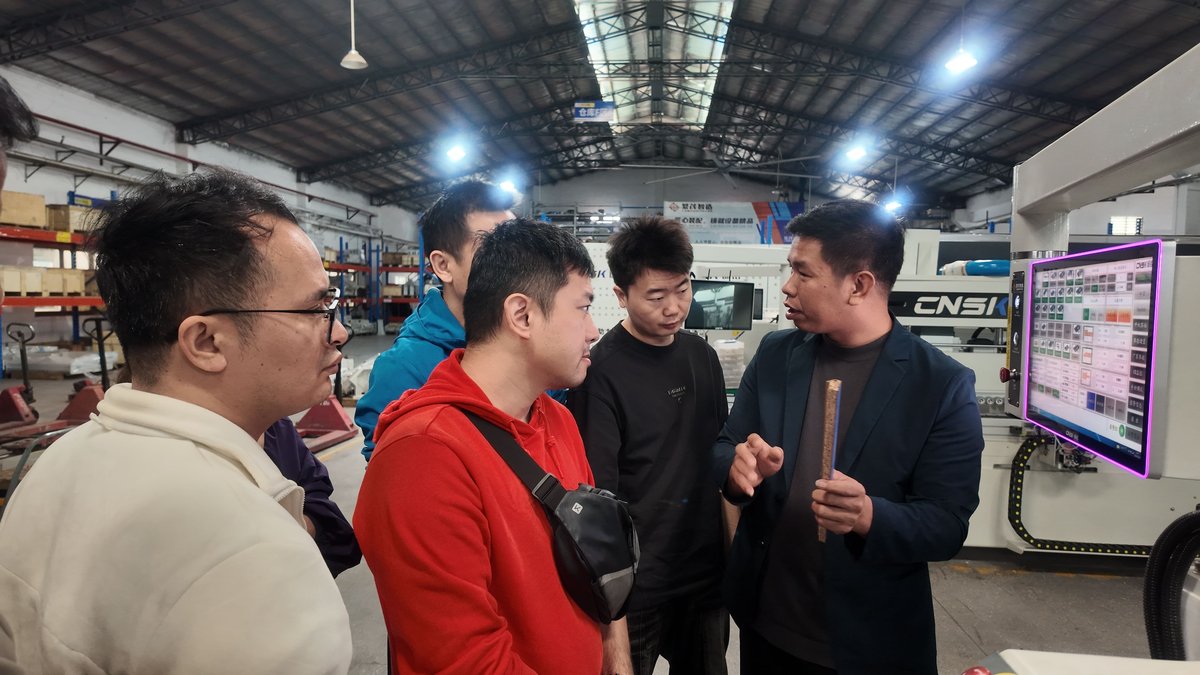
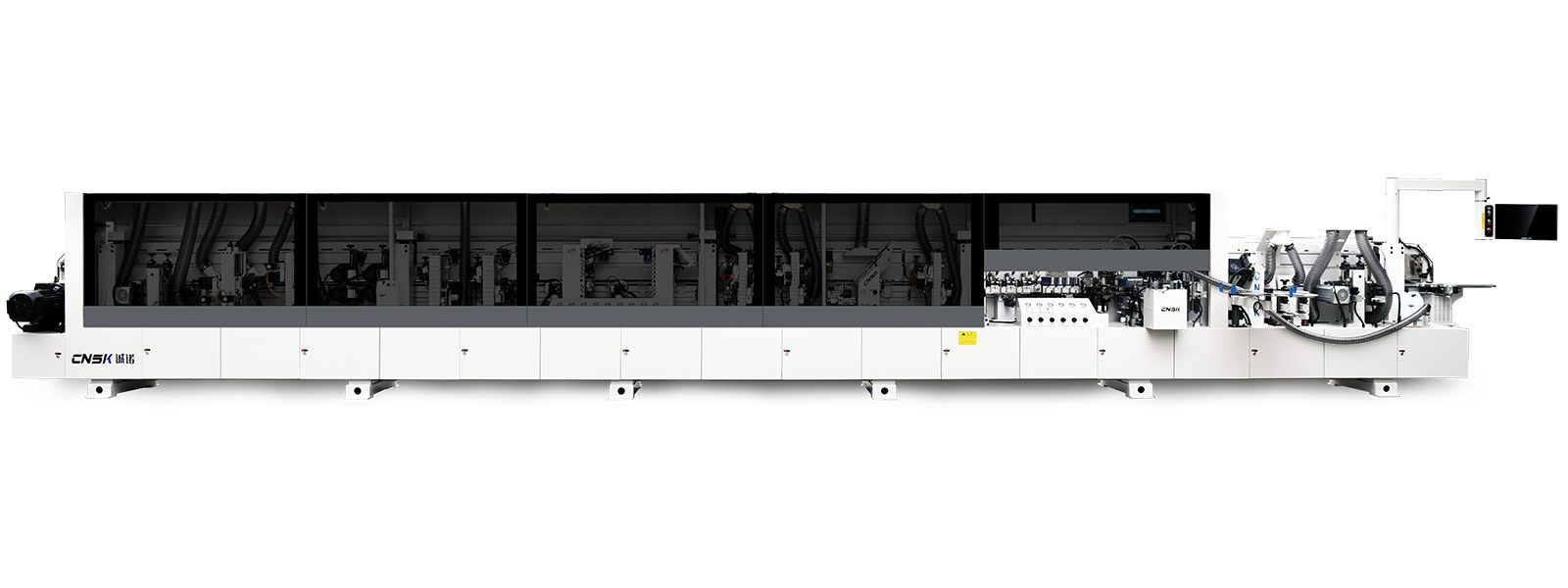
Guangzhou Snimay Home Collection Co., Ltd brought a team to our Dongguan plant in November to look at one machine: the FM820JCDH skeleton-line and grille edge bander. They did not open the parameter sheet first. They asked our technical team to walk the whole chain from the infeed — how the panel enters, how the skeleton line is formed, how the groove is cut, how the band goes on, how the corner is trimmed.
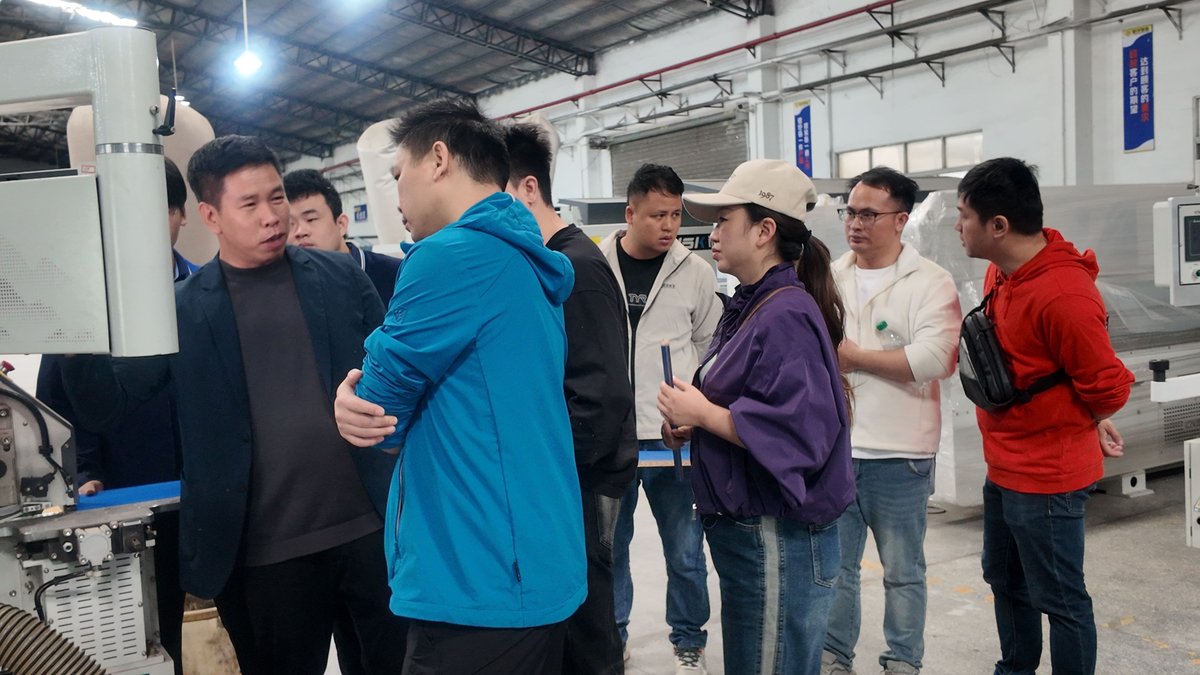
One machine, three jobs
The configuration sheet lists three tasks. Skeleton door panels come in two styles, straight edge and a 35° bevel, and the machine holds the panel by its concave face under a high-pressure beam on a crawler feed — the recess does not have to be packed level before banding. For a plant making skeleton doors, that packing step is the part that eats labour.
Skeleton line strips are the second job: straight, 35° bevel and grille, with the section size cut to the drawing.
Ordinary straight edge banding is the third. Three jobs on one machine means a door does not travel between three machines on its way from blank to finish.
Feed: the concave face is the whole problem
A skeleton door is hollow behind the face. A flat pressure shoe cannot hold it, so the panel drifts and the band depth varies along the edge.
The feed is a crawler under a high-pressure beam. The crawler wraps the panel over a wide contact area, the pressure is spread rather than concentrated, and the concave face is held by the belt itself. Feed speed is 16–23 m/min.
The operators asked the practical question: will the pressure still hold at the end of a full shift, and will the panel still run straight. Support across the width instead of at a few points is what keeps a thin or long part from riding up, and a clean belt face collects less dust over a day.
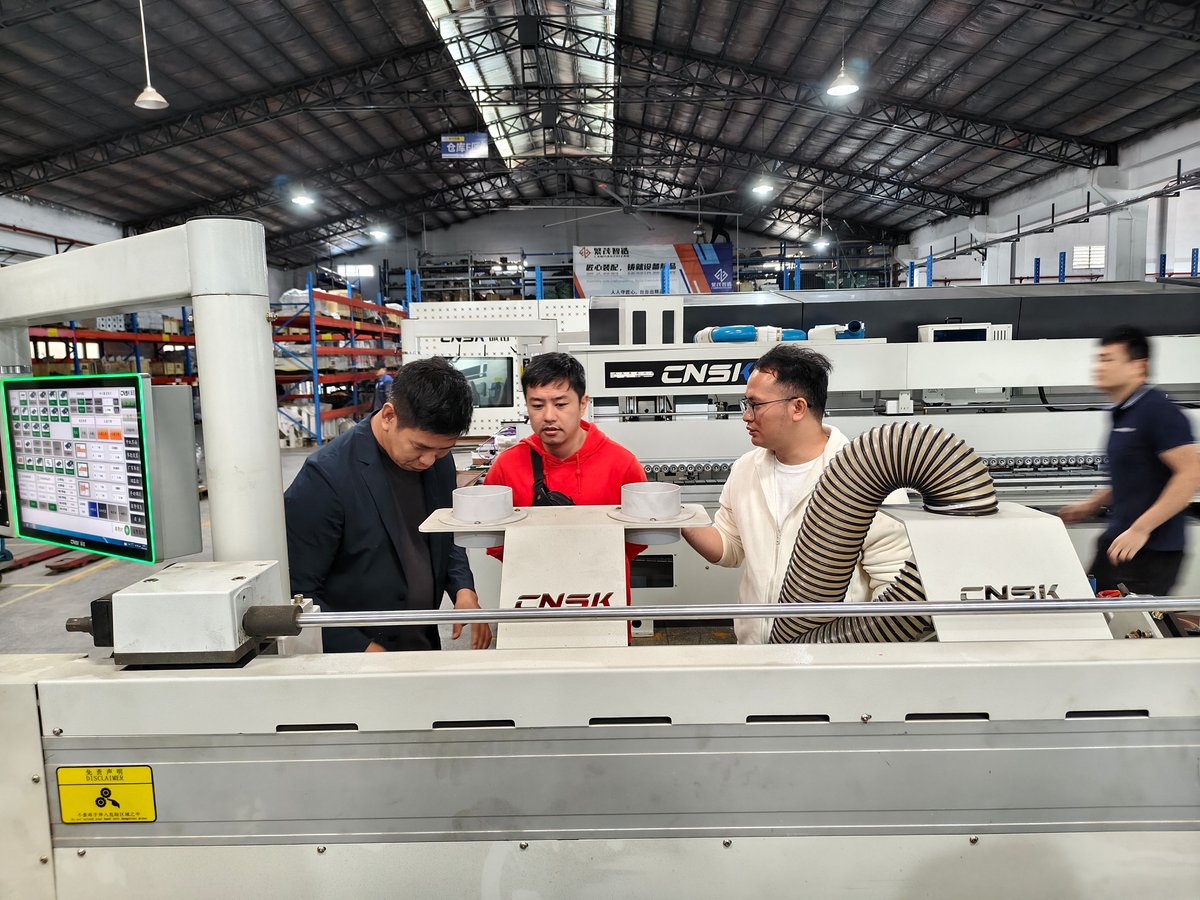
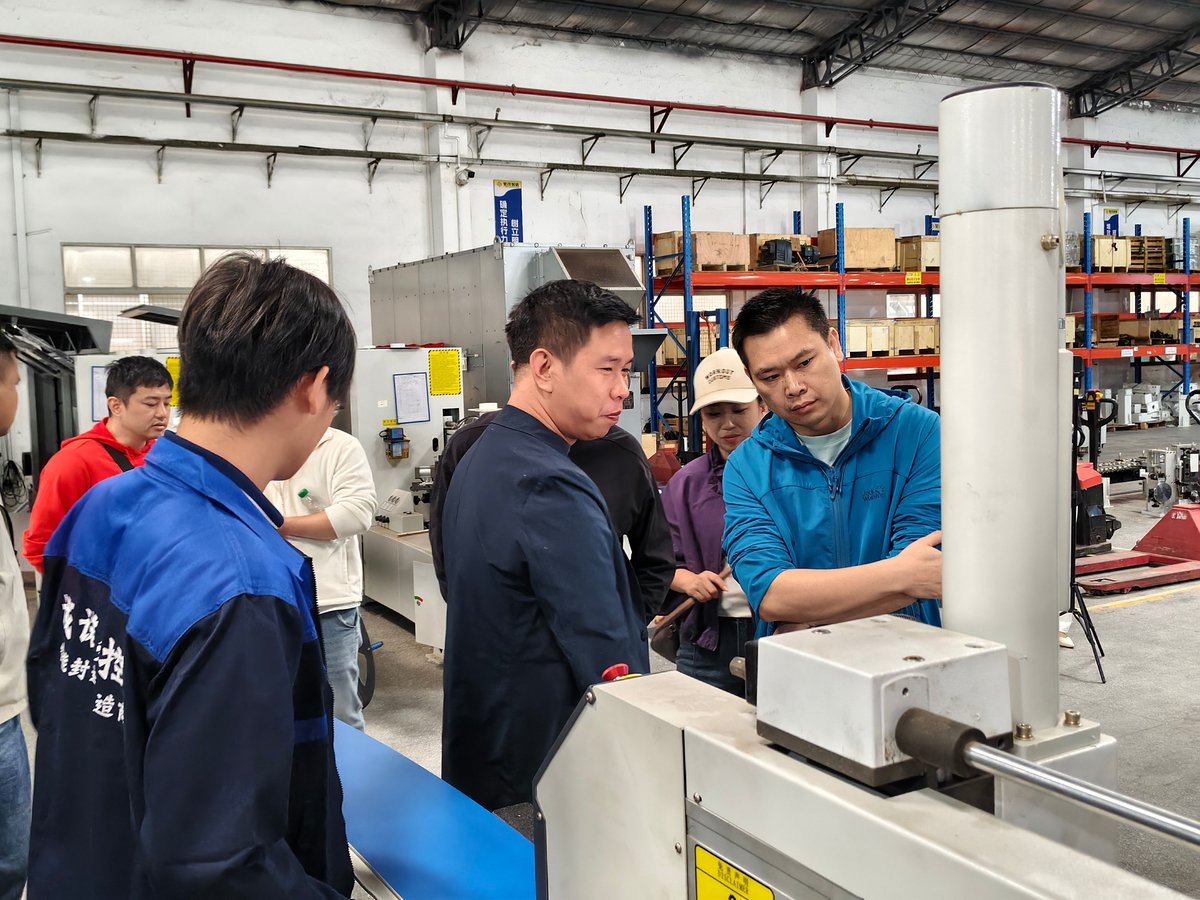
Levelling, then forming
Skeleton banding quality depends first on the flatness of the face the band lands on. After cutting and grooving, the side edge carries ripple marks, burrs and a vertical deviation. Left in place, the band sits on that face as a soft joint that whitens and lifts with time.
A pre-milling saw and pre-milling cutter at the infeed level that face. A twin-blade skeleton pre-milling unit then takes a second cut, so the edge reaches the band ready to receive it, with the end face squared.
Forming is handled by two separate units. A 35° saw produces the bevel that skeleton doors use. A 45° saw mills a straight edge into a 45° bevel in one pass, with its own PUR gluing station, so the bevel is bonded separately from the straight face.
From glue to polish without lifting the panel
Banding is not one action. On this machine the sequence runs in a single direction, and the panel is not taken off the line between steps.
| Step | Unit | What it does |
|---|---|---|
| Gluing | Two-colour non-cleaning glue + PUR glue pot | Covers the straight and the bevel condition |
| Band preparation | Band grooving | Cuts a groove on the inside of the band so it folds and presses cleanly at the corner |
| Pressing | Synchronised bevel and straight pressing | High-precision rollers, even pressure on both faces |
| End trimming | Combined bevel and straight end trimmer | Cuts and squares the leading and trailing ends |
| Edge trimming | Straight and bevel trimming, rough trim | Brings the band flush with the panel face |
| Corner rounding | Four-head corner tracking, four motors | Rounds the corner at speed with a consistent finish |
| Glue removal | Separator, cleaning unit, scraper | Separator keeps glue off the panel face; scraper removes cutter marks and residue |
| Polishing | Polishing 1 and 2 | Cotton wheels clean the finished edge |
What the visitors watched here was narrow and specific: whether the bevel corner stepped, whether the rounded corner was clean, whether the panel face carried glue marks.
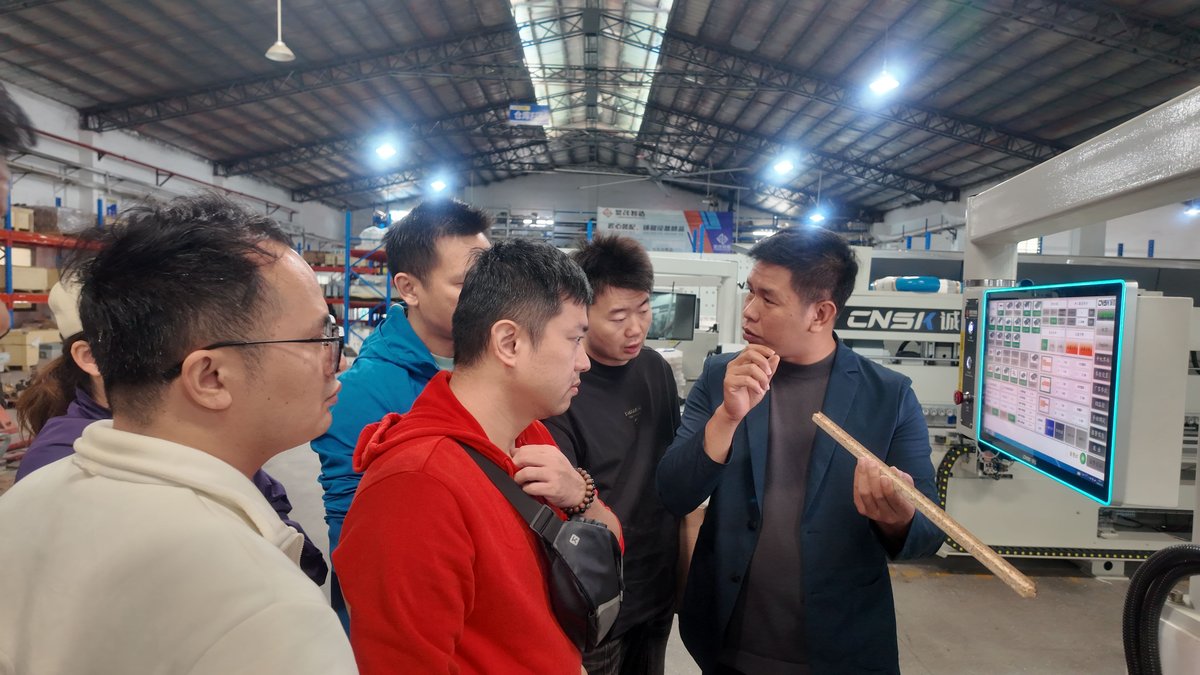
Nail-rack grooving: sixty days becomes two
This is the part of the configuration sheet where the walk-through stopped longest.
The traditional route for a skeleton line is glue, then a cold press, then wait for the adhesive to cure. The difficulty is not whether it can be done, it is how long it takes: the configuration sheet puts the traditional cycle at more than 60 days. With this machine and a pneumatic nail gun, the same line is made in one to two days.
What makes that possible is nail-rack grooving — a nail groove cut into the line strip at set spacing, which gives the nail gun something to hold. Three things follow. Glue use drops sharply, which also removes the adhesive-related environmental problem. The cold press queue disappears, so the cycle is counted in days instead of months. And the cost structure changes, because glue, press time, floor space and waiting all fall at once.
For a plant running skeleton door orders in batches, two days instead of two months changes the rhythm of taking orders: the customer does not sit waiting, and the cash cycle turns faster.
0.1 mm at the groove and the slitter
A skeleton line has to sit in its groove. If groove width, groove depth or strip size is off, the line sits loose or will not go in at all.
The bevel and straight grooving unit cuts 45° bevel grooves and vertical straight grooves in one setup, without changing the unit or moving the part to a second machine, and it covers handle-free, skeleton and grille panels. A separate grille grooving unit cuts panels and workpieces. The slitting assembly is driven by two motors, cuts cleanly, and slits bevel and straight stock in the same pass.
All of this is servo controlled, so depth, width and strip size are set rather than adjusted by hand. The configuration sheet gives cutting accuracy as 0.1 mm. On a production line the point is repetition: a line made this week fits a groove cut next month, and assembly does not have to rework it.
Two costs that are easy to miss
Colour. Skeleton lines have traditionally come from a fixed material in a fixed colour range, and matching the line to the panel is where the design stalls. Once the line is made from edge band, the colour and grain range opens up, and the line can be matched to the panel instead of the panel being chosen to suit the line. For high-end custom work that is a practical selling point, not a technical one.
Offcuts. Trim, damaged board and irregular pieces can be slit into line stock. That material used to leave the plant as waste; now it comes back as line, and the material yield moves up without a new supply contract.
Control: a parameter change without waiting for an engineer
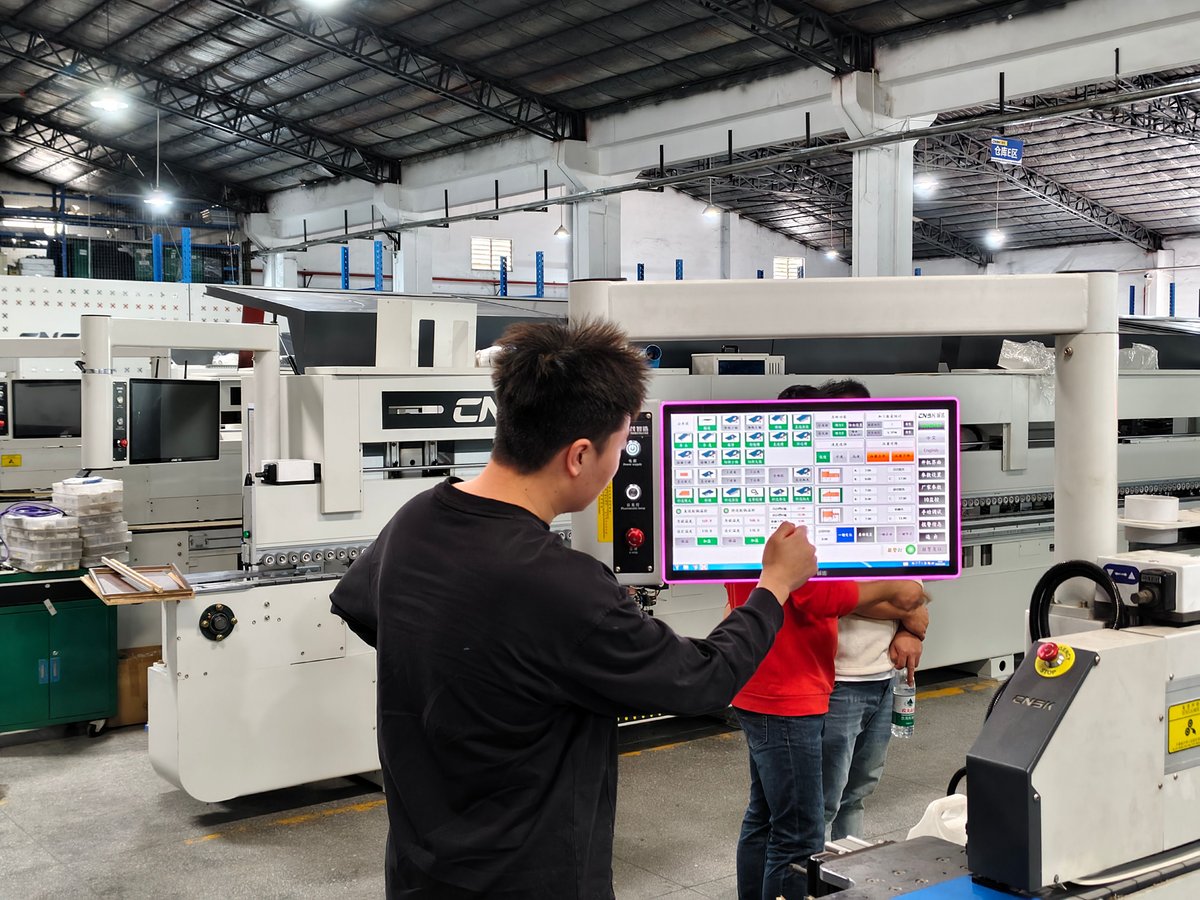
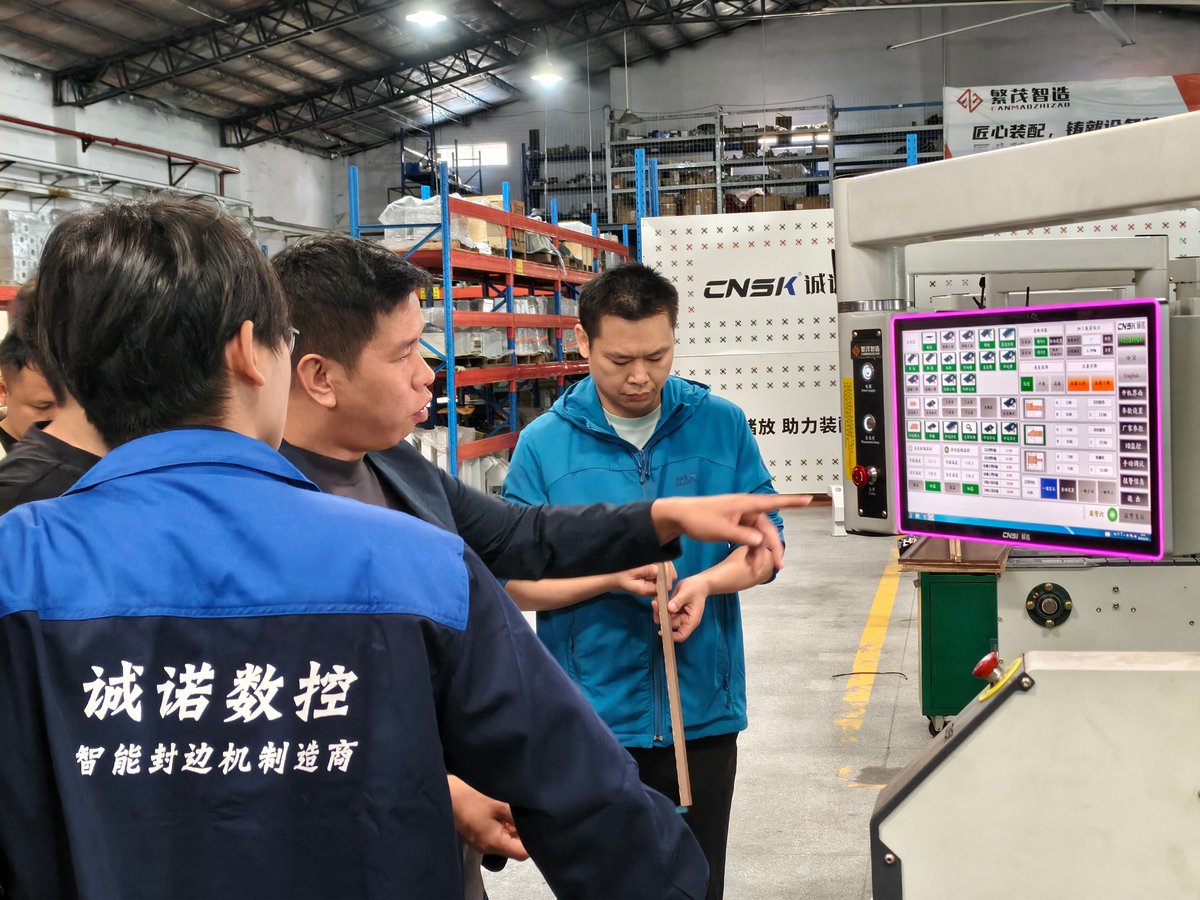
The terminal is a touch screen with an optional mouse and keyboard, it runs Windows, and it can be reached remotely.
Set points are entered on the screen. Remote connection covers system updates and fault finding, so a parameter change or a diagnostic does not wait for someone to travel to the plant.
The visitors tapped through the screens themselves. Their comment was that the layout is direct and the switching logic is clear enough to learn in an afternoon.
What the visit settled
The team compared samples against finished parts and looked at three things: the bevel corner, the clarity of the rounded edge, and how the groove and the line met. Their assessment of machine stability and consistency of output was positive.
No throughput ceiling was discussed. The question was whether three jobs chain on one machine without fighting each other. For a plant running skeleton and grille doors, that settles real output more than the speed of any single station.
Technical data
| Item | FM820JCDH |
|---|---|
| Model | FM820JCDH |
| Feed speed | 16–23 m/min |
| Lift adjustment | Motorised |
| Panel width, straight / bevel | ≥60 mm / ≥80 mm |
| Panel thickness, straight banding | 9–60 mm |
| Panel thickness, 45° bevel | 15–40 mm |
| Band thickness | 0.4–3 mm |
| Band width | 12–65 mm |
| Input voltage | 380 V |
| Air pressure | 0.7 MPa |
| Total power | 60 kW |
| Machine dimensions (L×W×H) | 13020×900×1690 mm |
Figures follow the configuration sheet. Custom configurations are available against the profile and panel sizes a plant actually runs.
Send the panel spec. Get a configuration, not a catalogue.
Thickness, width, band material and the profile you sell. That is enough to put a station list and a price against your name.